Data Centers and the Community Trust Constraint
Separating myths from real impacts—and what developers must prove next.
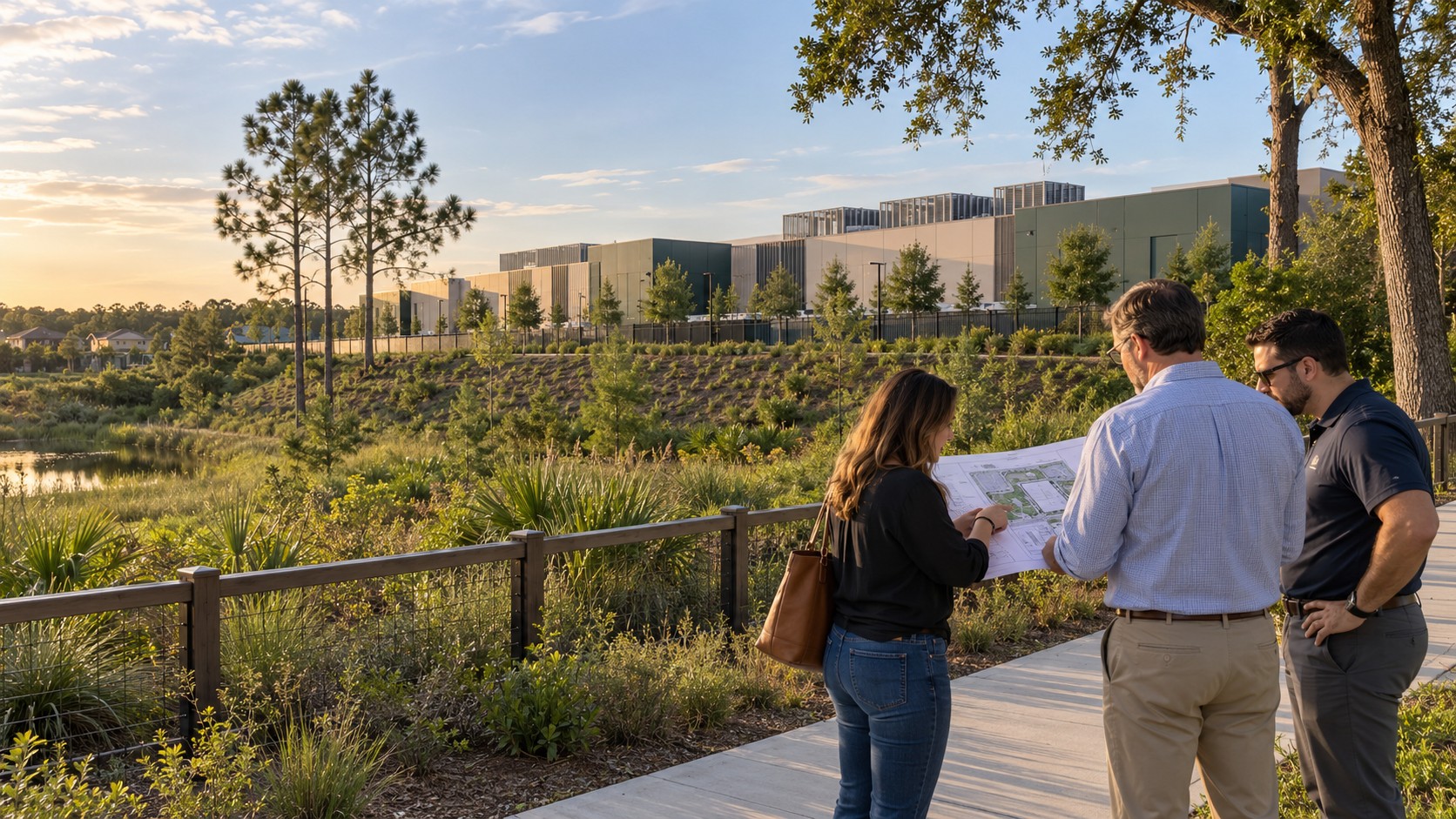
Narrated educational short · AI-generated illustrative footage, branded animation, music, and English captions.
Data centers are becoming a more visible part of our communities. Yet the services they support often feel more familiar than the buildings themselves: cloud software, business systems, communications, and increasingly, artificial intelligence.
Residents see the physical consequences first: land clearing, construction traffic, cooling equipment, substations, and the possibility of new demands on local infrastructure.
That creates a gap between the industry’s promise and the community’s experience.
Some claims about data centers are overly broad. Some concerns are well founded. Treating every objection as misinformation makes it harder to distinguish the two—and harder to develop projects that deserve public confidence.
GreanSea’s perspective: community trust can become a development constraint when project commitments are unclear, unproven, or disconnected from operating reality.
The electricity question is substantial
Berkeley Lab’s United States Data Center Energy Usage Report: 2025 Update, published in June 2026, projects a reference case in which data centers consume 11.8% of U.S. electricity by 2030, with an estimated range of 9.5%–15.3%. These are modeled scenarios, not measured 2030 outcomes or forecasts for an individual community.[1]
Those figures justify serious planning. They do not establish whether a particular facility has secured adequate power, who will pay for upgrades, or whether its proposed location is appropriate.
National growth statistics start the discussion. Project-specific evidence must finish it.
Five assumptions that need a closer look
1. “Every data center uses enormous amounts of local drinking water.”
Water impacts depend on the facility, cooling design, climate, and source of supply. DOE guidance describes how cooling-tower consumption depends on heat load and system efficiency. Berkeley Lab research also distinguishes water used at the facility from water associated with electricity production.[2][3]
The useful question is therefore: What will this project withdraw and consume, from which source, during normal operations and peak conditions?
Developers should explain annual demand, seasonal peaks, drought assumptions, and the evidence behind any efficiency claim. A reassuring label such as “advanced cooling” is not a water budget.
2. “Data centers automatically make everyone’s electricity bill higher.”
The outcome depends on utility investment, rate design, cost allocation, and whether forecast demand materializes. Virginia’s JLARC review found that the rates it examined allocated existing costs appropriately, while warning that future demand growth could increase other customers’ costs.[4]
That finding is specific to the study’s place, period, and assumptions. It supports neither a universal promise of no impact nor a universal prediction of higher bills.
Communities should ask who funds new infrastructure, what commitments large customers make, and who bears the cost if planned demand does not arrive.
3. “Noise complaints are just resistance to change.”
Persistent sound deserves investigation. Loudoun County explains that conventional A-weighted sound measurements may not adequately capture low-frequency or steady tonal noise. Its requirements include noise studies before and after construction.[5]
The implication for project teams is practical: a design that satisfies one measurement standard may still require attention to what nearby residents experience.
Specify the sound conditions being evaluated, measure at relevant receiving locations, and establish a response process. Distinguish temporary construction noise from ongoing operation and generator testing. Avoid dismissing a complaint simply because equipment is functioning as designed.
4. “Data centers bring no meaningful local value”—or “they create huge permanent workforces.”
Both claims oversimplify the economics. JLARC’s Virginia review found substantial benefits associated with construction, fewer ongoing employees than some other industries, and potentially significant local tax revenue. Actual revenue depends on the market, tax structure, and incentives.[4]
A credible proposal separates construction employment, ongoing facility roles, contracted services, local procurement, and net fiscal benefits. Communities should be able to see which benefits are temporary, which recur, and which depend on future decisions.
For local MEP and service firms, opportunity must also become accessible through realistic procurement, qualification, and workforce pathways.
5. “Once a project receives approval, the community issue is resolved.”
Approval is a milestone. The relationship continues through construction, commissioning, expansion, and maintenance.
GreanSea’s view is that trust depends on whether commitments survive those handoffs. A water assumption, acoustic requirement, or generator-testing commitment must reach the people who select equipment, install it, verify it, and maintain it.
The handoff fails when a promise remains in a presentation but never becomes a funded task with an owner and evidence of completion.
What this means for future development
Public scrutiny can influence where projects are proposed, how they are designed, and the conditions under which they proceed. In Loudoun County, amendments approved in March 2025 moved data centers toward conditional or special-exception review in areas where they previously could proceed by right. Additional standards work remains underway.[6]
This is one jurisdiction’s response, not a national rule. It illustrates a development risk that project teams should evaluate locally.
GreanSea expects the following issues to become more important in project selection and execution:
- Site fit: distance from sensitive uses, surrounding infrastructure, and the cumulative effects of nearby development.
- Resource commitments: credible power and water plans, including peak conditions and infrastructure responsibilities.
- Design evidence: acoustic analysis, equipment selection, construction controls, and verification under relevant operating conditions.
- Community accountability: accessible information, a named contact, documented complaints, and tracked corrective actions.
- Lifecycle performance: operating and maintenance practices that preserve the conditions under which the project was accepted.
These are strategic implications, not a forecast that every locality will adopt the same requirements. Some sites may remain suitable; others may need redesign, different phasing, or a different location. Technical feasibility alone does not answer every land-use question.
Turn community commitments into operating requirements
For MEP contractors and mission-critical service firms, this creates an execution opportunity: help make the project’s commitments verifiable.
An illustrative project team could use the following record. It is a proposed management tool, not a description of a GreanSea client engagement.
| Commitment | Evidence to define | Accountable lead | Follow-through |
|---|---|---|---|
| Cooling demand fits the approved resource plan | Design assumptions, metering approach, and agreed operating limits | Owner’s engineering lead with the relevant utility | Compare actual demand with assumptions; investigate variance |
| Equipment meets agreed sound conditions | Acoustic criteria, equipment data, and a verification plan | Acoustic specialist supported by MEP teams | Validate after installation and after material equipment changes |
| Backup-power operation follows applicable conditions | Permit requirements, test procedures, and operating records | Facility operator with qualified service providers | Review records and address exceptions |
| Residents can obtain a response | Named contact, issue log, response expectations, and escalation owner | Owner’s community liaison | Track issues through verified closure |
The governing constraint may be an unresolved utility decision, an acoustic design gap, missing accountability, or insufficient technical capacity. Identify which condition actually prevents progress before adding activity elsewhere.
More outreach cannot substitute for a workable technical plan. Better equipment cannot substitute for clear accountability. Both must connect to delivery.
What this means for Central Florida
Central Florida should assess proposals against its own utility capacity, water conditions, neighboring uses, workforce, and local requirements. Results from Virginia or another established market can inform the questions; they cannot establish the answer for an Orlando-area site.
For firms supporting AI data infrastructure, the commercial opportunity is to help owners demonstrate reliable performance from design through ongoing service—and to be precise about the capabilities and commitments they can deliver.
The GreanSea perspective
Data center development does not benefit from blanket opposition or blanket reassurance. It benefits from understandable evidence, appropriate siting, realistic commitments, and disciplined execution.
Community trust is earned when the project people were promised matches the project they experience.
At GreanSea, we help MEP, construction, and mission-critical firms supporting AI data infrastructure answer three important constraint questions: What to change? What to change to? How to cause the change?
Our Operational Constraint Diagnostic identifies the conditions limiting throughput and growth. Our structured, multi-step improvement implementation process helps turn that clarity into focused action.
Sources and scope
- Lawrence Berkeley National Laboratory, United States Data Center Energy Usage Report: 2025 Update, published June 2026. National modeling and uncertainty range; not a local project forecast. Report summary.
- U.S. Department of Energy, Cooling Water Efficiency Opportunities for Federal Data Centers. Technical guidance.
- Berkeley Lab, The environmental footprint of data centers in the United States. Used for the distinction between on-site and electricity-related water impacts, not its older national electricity-share estimate. Research summary.
- Virginia Joint Legislative Audit and Review Commission, Data Centers in Virginia, December 2024. Findings reflect Virginia and the study period. Study summary.
- Loudoun County, Data Centers: Noise & Air Quality Concerns. Referenced for noise measurement limitations and study requirements, not as a rule applicable outside that jurisdiction. County guidance.
- Loudoun County, Data Center Standards & Locations. Describes adopted March 2025 changes and ongoing standards work. Planning project.
Sources reviewed November 1, 2026. Forward-looking development implications and the illustrative management framework are GreanSea’s analysis. Project requirements depend on the location, utility, permits, and actual scope.